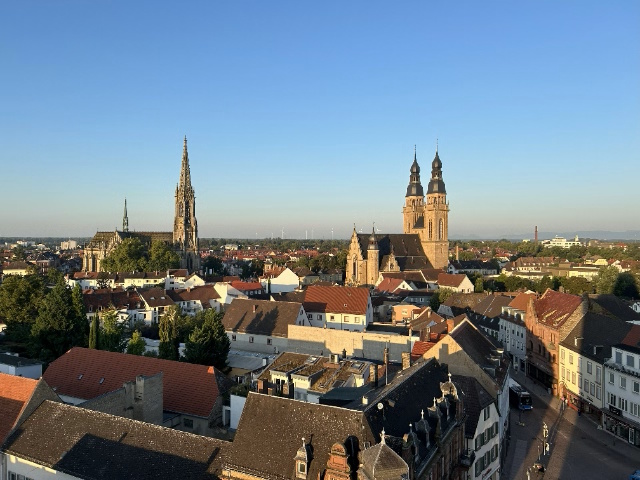
2,000 Years of Speyer in 20 Seconds
- 10 BCE – Speyer is founded as Noviomagus by the Romans.
- Around 614 – The name Spira appears for the first time
- 1024 – Conrad II becomes King of the Romans; crowned Emperor in 1027
- 1030 – Construction of the monumental Speyer Cathedral begins.
- 1076 – Emperor Henry IV departs from Speyer for the famous Walk to Canossa
- 1084 – First Jewish families settle in Speyer; the first synagogue is built, followed later by the Mikveh near the cathedral.
- 16th century – Speyer becomes seat of the Imperial Chamber Court and hosts several Imperial Diets, including the Diet of 1529, where the famous Protestation occurs.
- 1689 – Speyer is nearly destroyed during the War of the Palatine Succession.
- 1816 – Speyer becomes district capital and seat of government for the Bavarian Rhine District.
- 1991 – The Technik Museum Speyer is founded, now home to a Boeing 747 and Europe’s largest space exhibition.
Jump to…
| Cathedral | Jewish Courtyard, Trinity Church, Old town |
|---|---|
| - Surround | - Jewish Courtyard |
| - West | - Trinity Church |
| - South | - Old town |
| - East | |
| - Heathen Wall | |
| - North | |
| - Inside | |
| - Crypt |
City walking tour
Surrounding the Cathedral
Statues of Konrad II, Henry III, Henry IV and Henry V
- Conrad II, the first Salient Emperor with his wife Gisela. He started to build the cathedral in 1030
- Henry III
- Henry IV made the cathedral even bigger and also fought with Pope Gregor VII on the Investiture Controversy, his “Walk to Canossa”
- Henry V was crowned emperor in 1111 and died 1125 without any children
.jpg)
Pretzel - Invented in Speyer?
- Speyer as the birthplace of the pretzel legend: Local tradition claims that the first pretzel was created by monks in Speyer during the early Middle Ages as a reward for children learning prayers.
- Religious symbolism: The pretzel’s distinctive shape—arms folded in prayer—reflects its origin in Speyer’s monastic culture and its role in Christian fasting traditions.
- Cultural heritage: Today, Speyer celebrates this connection through bakeries and regional festivals, making the pretzel an enduring symbol of Rhineland culinary history.
.jpg)
Speyer and the English Crown
- Matilda of England, daughter of Henry I of England, wife of “our” Henry V, moved to England after Henry V deaths, and became the mother of Henry II of England. She was also the grand-mother of Richard I of England (Richard the Lionheart)
- Richard the Lionheart was held captive in Speyer in 1193 (returing from the Third Crusade and captured near Vienna by Duke Leopold of Austria), and was only released after 150.000 Silber Mark were paid
.jpg)
Cathedral – West Side
.jpg)
Cathedral Facade
- Constructed between 1854–58 based on plans by architect Heinrich Hübsch (Hübsch = Beautiful)
.jpg)
Evangelists
- John is symbolized by an eagle
- Matthew is symbolized by an angel
- Luke is represented by an ox
- Mark is depicted by a lion
.jpg)
Five Patron Saints
- St. Stephen
- Archangel Michael
- Holy Mother Mary
- John the Baptist
- Bernard of Clairvaux
.jpg)
Pretzel Boy / Brezelbub
- The “Pretzel Boy,” also known as “Pretzel Ferdinand”
.jpg)
Deadly Sins
- Moral Warning in Stone: The west façade features sculptural representations of the Seven Deadly Sins—pride, greed, lust, envy, gluttony, wrath, and sloth—serving as a visual reminder of Christian ethics.
- Romanesque Symbolism: Each sin is carved into figures or scenes that contrast virtue and vice, reflecting the medieval belief in teaching morality through art.
- Educational Purpose: These depictions were intended to guide pilgrims and townsfolk, illustrating consequences of sinful behavior in an era when most people were illiterate.
.jpg)
.jpg)
.jpg)
Cathedral Bowl
- Stone of Shame
- Free Wine
.jpg)
Cathedral – South Side
Fire burn Marks from 1689
- To the right of the fire ladder the burned stones can be seen (big fire of 1689)
.jpg)
Mount of Olives
- Depiction of Christ’s Agony: The Mount of Olives group shows Jesus praying in Gethsemane before his arrest, a powerful representation of his solitude and suffering.
- Late-Gothic Masterpiece (ca. 1505–1512): Commissioned by the Speyer cathedral chapter in the early 1500s, initial work began around 1505–09 under sculptors Hans and Lienhard Seyfer (and possibly Nikolaus Elser), with final completion around 1512.
- Historical Resilience: Originally central to the cathedral cloister, this sculptural ensemble was largely destroyed in 1689 and again during the French Revolutionary era. It was later restored in the late 19th century, and today’s figures were reimagined by Speyer sculptor Gottfried Renn (1856), preserving the site’s religious and artistic legacy.
.jpg)
East Towers
Cathedral – East Side
Oculus
- At the Equinox, twice each year (20 March and 23 September), at sunrise, the sun shines through this window illuminating the cathedral in a magical light
.jpg)
Drum Relief
- Two Snakes at the top - or is it a Prezel?
%20(Small).jpg)
Heathen Wall
- According to legend, the giant Olp lived here :-)
.jpg)
Cathedral – North Side
Construction Phases
- Left (East): Older stones with more visible mortar, indicating earlier construction techniques.
- Middle: Newer, larger, more uniform stones with less mortar, reflecting advancements in stone-cutting technology after the destruction of the fire in 1689.
- Right (West): A return to older stonework, again with more mortar, and including a pyramid-style facade from the late 18th century.
.jpg)
Afra Chapel
- After Henry IV death in 1106, and while still excommunicated, he was temporarily buried here. His son, Henry V, later secured the lifting of the ban, allowing for his reburial in the cathedral in 1111.
.jpg)
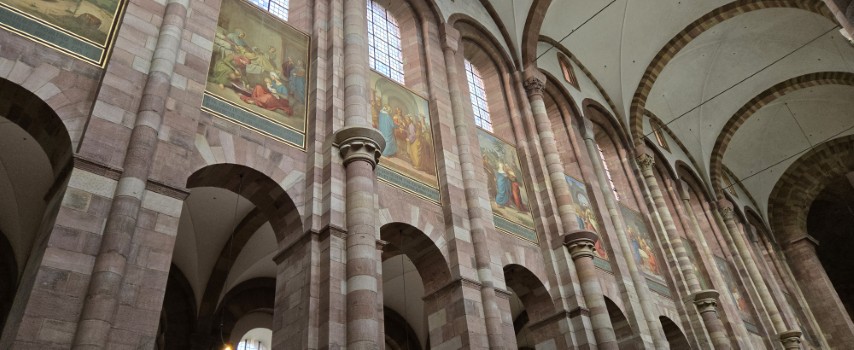
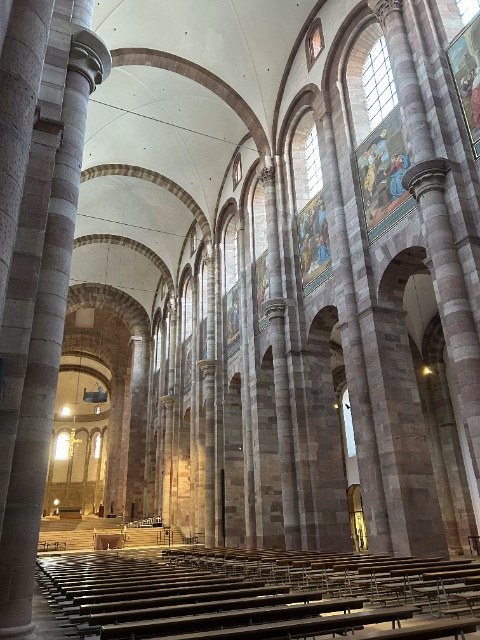
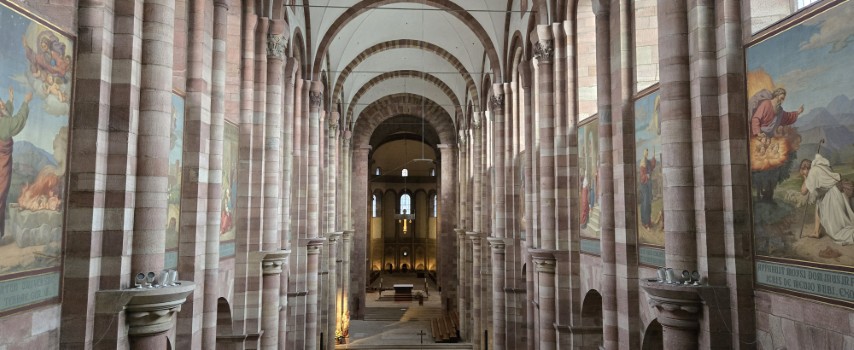
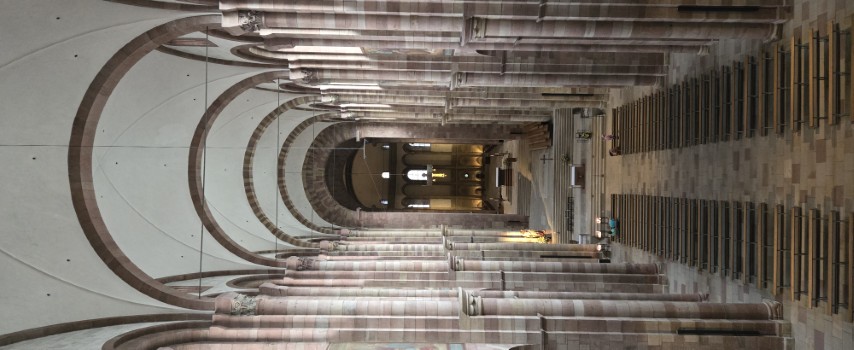
Inside the Cathedral
- Simple, but majestic
.jpg)
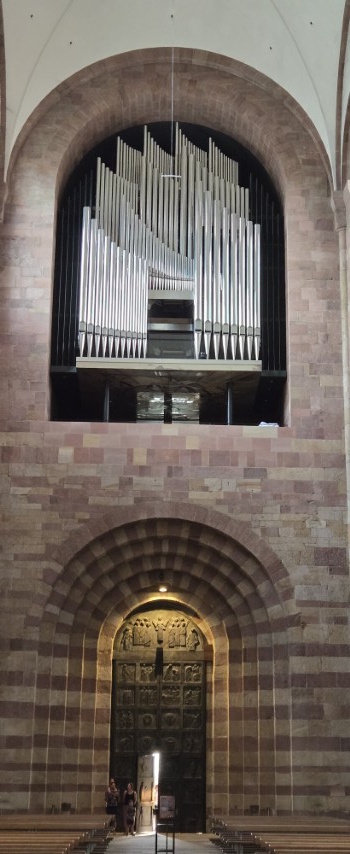
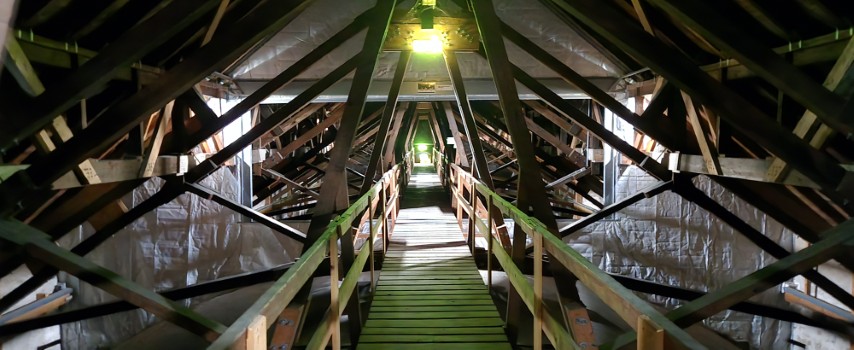
Dachstuhl
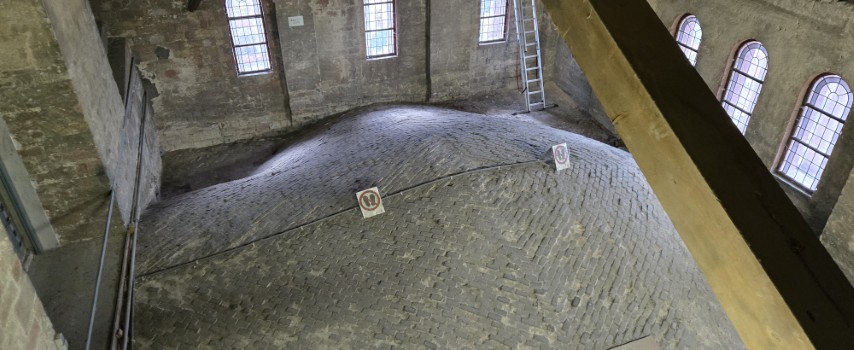
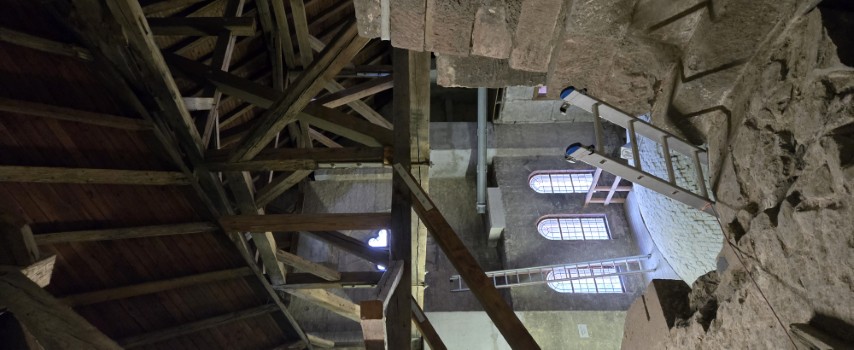
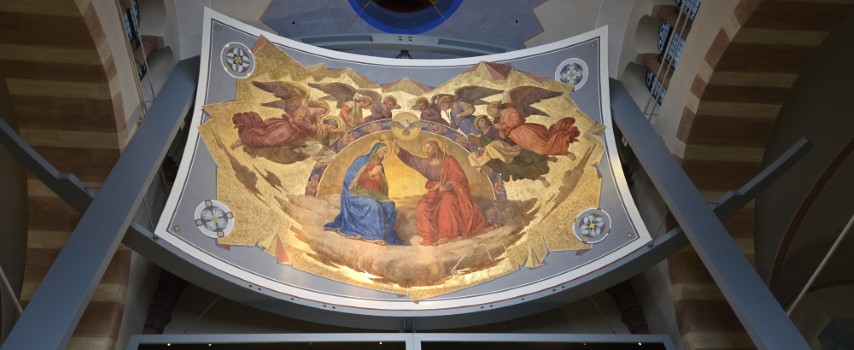
Kaisersall
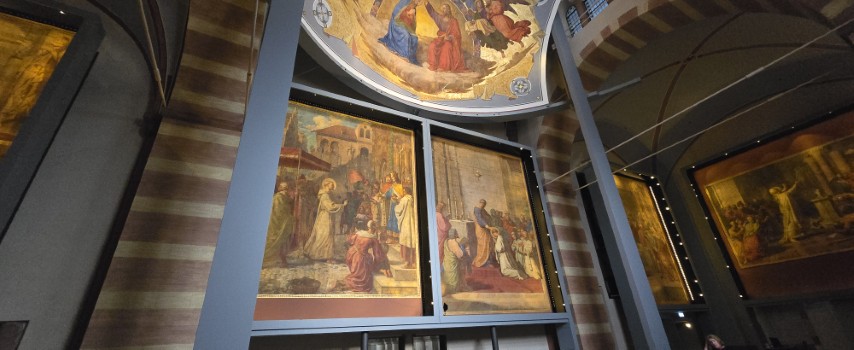
Inside
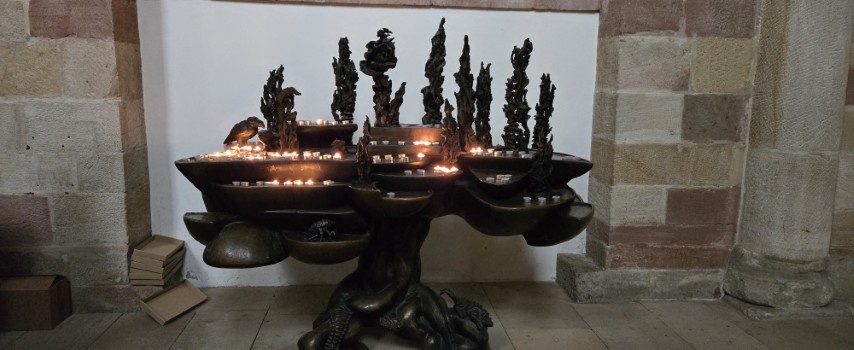
Modell
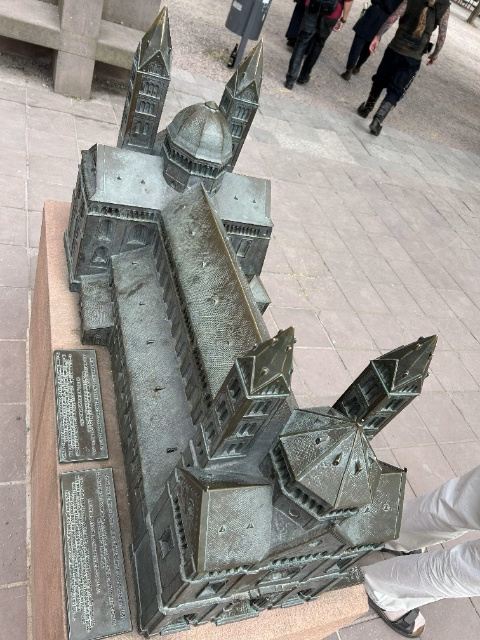
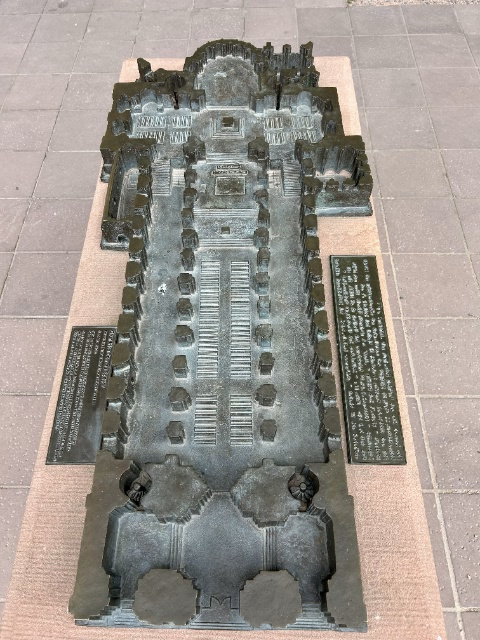
Small holes across all walls
- The cathedral was completely painted in the 19th century, to make it stick, thousands of holes were cut in the walls
- Only after 1957 were most of the paintings removed (some of them can still be seen in the Kaisersaal)
.jpg)
O clemens, o pia, o dulcis virgo Maria
- “O clemens, o pia, o dulcis virgo Maria” translates to “O merciful, O loving, O sweet Virgin Mary”. It is a devotional invocation expressing reverence and trust in Mary’s compassion and intercession.
- According to tradition, Bernard of Clairvaux spoke these words during his visit to Speyer Cathedral at Christmas in 1146, emphasizing Marian devotion as part of his preaching for the Second Crusade.
- These lines form the closing of the hymn Salve Regina, one of the most famous Marian antiphons in Catholic liturgy, sung during evening prayers and pilgrimages throughout the Middle Ages.
.jpg)
Crypt
- The largest Romanesque columned hall crypt in Europe
- Eight emperors and kings and a number of their wives are buried here:
- Conrad II (died 1039) and his wife Gisela (died 1043)
- Henry III (died 1056), son of Conrad II.
- Henry IV (died 1106), son of Henry III, and his wife Bertha (died 1087)
- Henry V (died 1125), son of Henry IV.
- Beatrice I (died 1184), second wife of Frederick Barbarossa and their daughter Agnes
- King Philipp of Swabia (died 1208), son of Frederick Barbarossa
- King Rudolph of Habsburg (died 1291)
- King Adolph of Nassau (died 1298)
- King Albert I of Germany (died 1308), son of Rudolph of Habsburg
.jpg)
- Notice the three iron belts on the grave of Emperor Conrad II
.jpg)
Jewish Courtyard
Wise men of Speyer
- Medieval Scholars of Speyer: In the 12th century, Speyer emerged as a prominent center of Jewish learning within the SHUM network. Its rabbis and teachers became renowned across Europe, earning the collective title “Wise Men of Speyer”
- Lived in the Jewish Courtyard (Judenhof): These scholars were based in the locus of Jewish intellectual life next to the cathedral. The Judenhof—comprising synagogue ruins, the women’s shul, and the mikveh - serves as the historical setting where their theological teachings and halakhic rulings were formed.
- The museum highlights their influence on Ashkenazic Judaism through artifacts such as synagogue architectural fragments, Hebrew inscriptions, gravestones, and educational materials that preserved their scholarly legacy.
.jpg)
Synagogue
.jpg)
Frauenschul (Women’s Synagogue)
- Built in the 13th century, it was a dedicated space for women to pray, and listen to what was happening in the Synagogue
.jpg)
Mikveh
- Dating back to the early 12th century, this is the oldest preserved ritual bath north of the Alps, with crystal-clear groundwater still visible today
.jpg)
.jpg)
.jpg)
.jpg)
Trinity Church
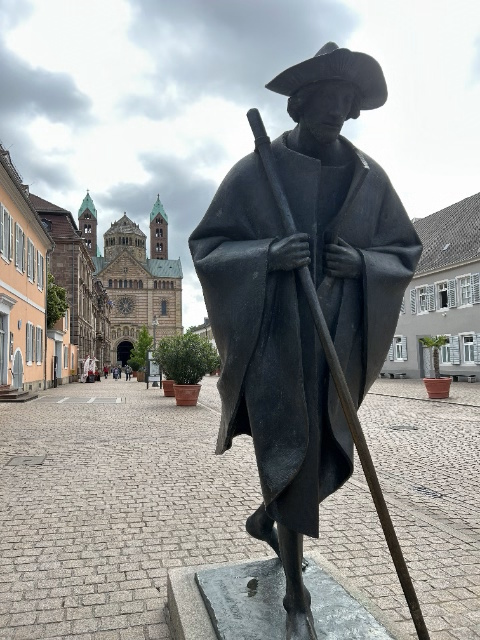
- The Trinity Church is one of the most beautiful churches. Here shown with a pilgrim on the Way of St. James / Camino de Santiago from the outside.
.jpg)
.jpg)
- Video with guest from the US performing in the Trinity Church during our tour
.jpg)
Retscher Ruins
- “Steinreich” / Stone-Rich / Filthy Rich
.jpg)
.jpg)
Bell Tower
- The tower originally belonged to the medieval Catholic St. George’s Church, built in the 13th century.
- After the church was destroyed in 1689, the tower remained and was later restored.
- Today, this former St. George’s tower serves as the bell tower for the Protestant Trinity Church (Dreifaltigkeitskirche) in Speyer.
.jpg)
Picture of Cathedral
.jpg)
Old Town
Sonnenbrücke
.jpg)
Fish market
.jpg)
Synagoge
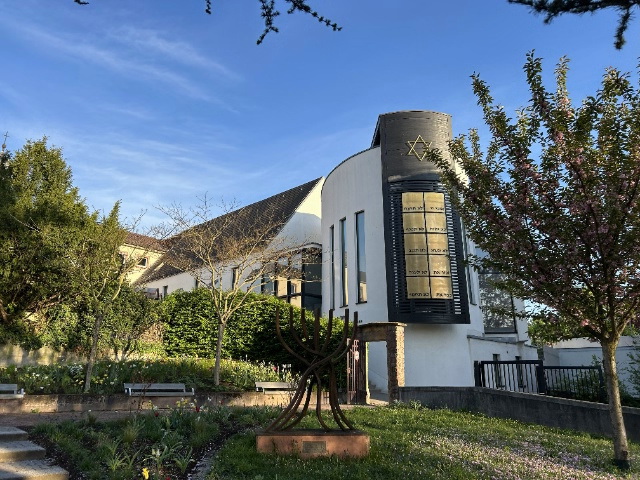
To be continued…
Main Street / Via Triumphalis / Maximilianstreet
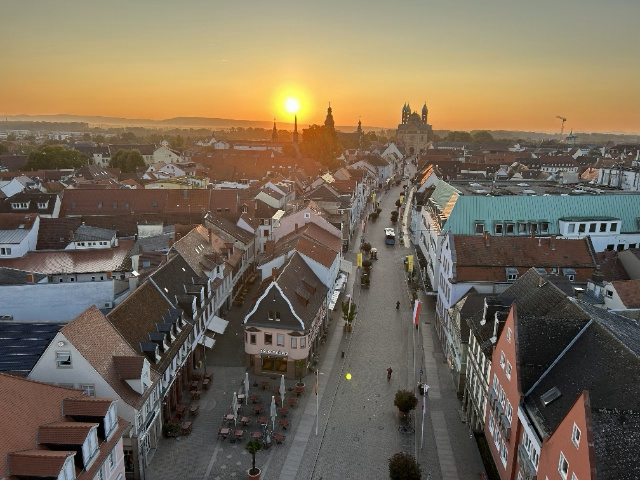
Stuhlbrudergasse
Domhof
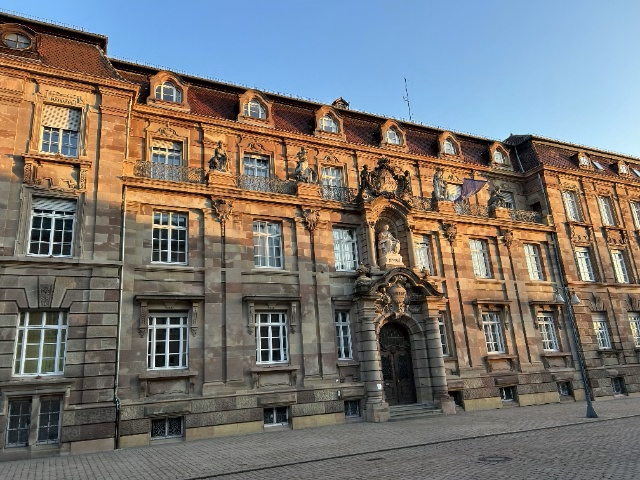
Stadthaus
Sophie La Roche
Jakobspilger
Georg der Drachentöter
Alte Münze
Rathaus
Unicorn Phramacy
- One of the ten oldest pharmacies in Germany, mentioned 1457 as Pharmacy at the market
Old Gate / Altpörtel
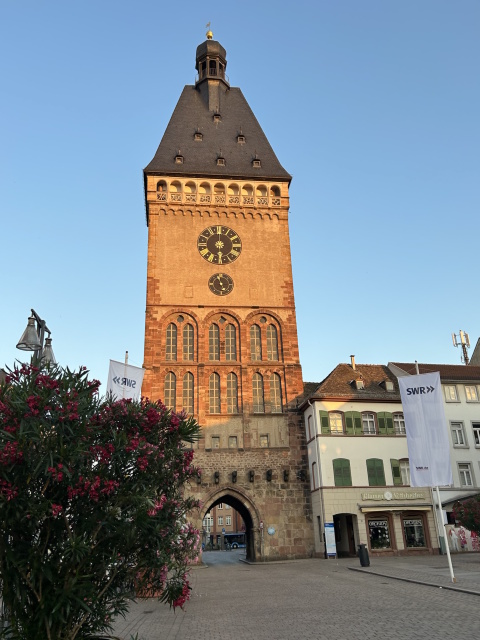
Clocks
Spire Shoe
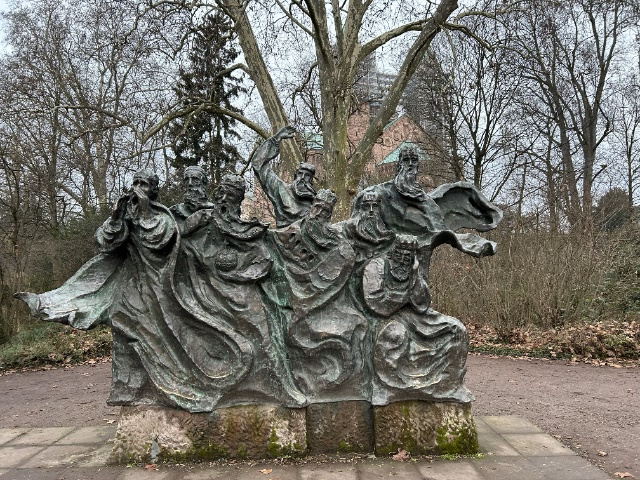
Fährmann
- Nightly Summon of the Emperors - In October 1813, shortly after the Battle of Leipzig, five phantom emperors—believed to be the deceased Salian kings interred in Speyer Cathedral — are said to have risen from their tombs and called out across the Rhine to a sleeping ferryman, urging him to ferry them to help defend the German realm against Napoleon.
- Mysterious Crossing & Golden Tokens - The ferryman obeyed at midnight, transporting these regal apparitions across the river. Upon returning several nights later, he found gold coins bearing the emperors’ likenesses in his pocket—believed to be a “thank you” token from the companions he unknowingly ferried.
- Symbolic Remembrance via Sculpture - This romantic legend is commemorated by the 1987 bronze sculpture “Fährmann hol’ über” by Günther Zeuner, located in the cathedral garden. It portrays the ferryman and the emperors, immortalizing their nocturnal journey as a patriotic allegory of national salvation.
Postplatz
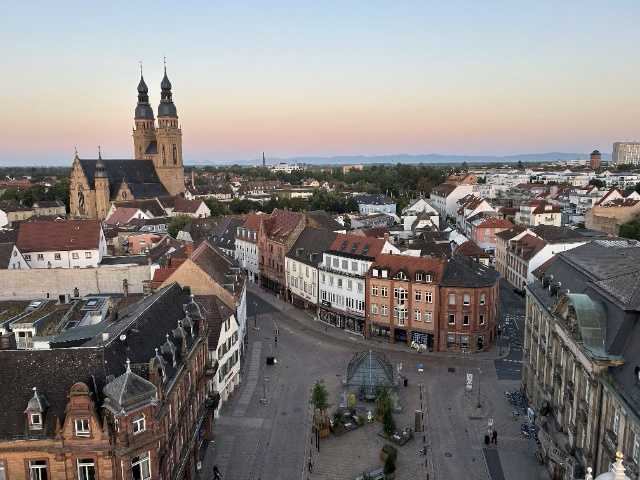
Gedächtniskirche + Johanneskirche